Lab 128
Oracle tuning and performance troubleshooting
Lab128 is a tool for Oracle tuning and performance troubleshooting used by Oracle DBAs, Performance Analysts, Consultants, and Senior Developers. It is beginner-friendly for learning Oracle and has been available for over 10 years, with usage across Fortune 500 companies, high-profile universities, banking, oil, health, and many other industries worldwide.
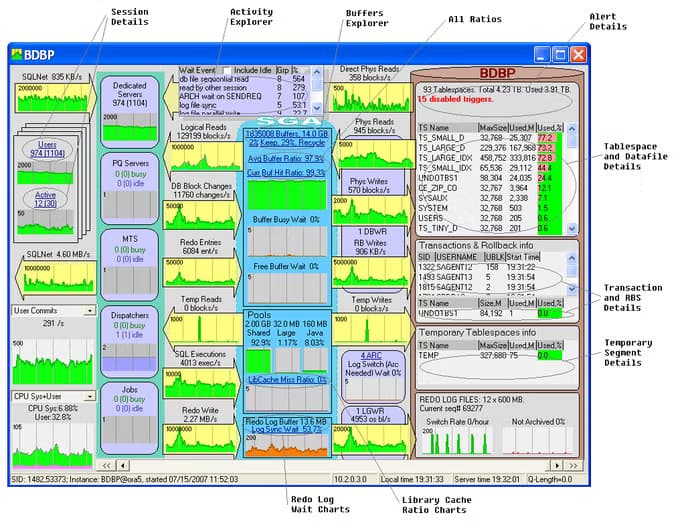
Lab 128 Unique Features
Lab128 helps maintain the database at peak performance where no other tool offers the same function coverage. Its unique feature set is designed to make troubleshooting and tuning faster, more precise, and more practical in production environments.
- Captures all statistics originated from
v$sysstat,v$system_event,v$filestat,v$rollstat,v$latch, and many more - more than 3,000 statistics, each recorded every 6-12 seconds. - Uses Frequent SQL Statistics Snapshots (
FSSS) technique. - Implements internal Active Session History (
ASH) with a higher collection rate than native OracleASHand supportsASHfor8iand9i. - Provides a dedicated technique for diagnosing troubled SQL statements.
- Offers Stage and Fix to improve SQL execution plans without changing SQL text.
- Includes Buffer Explorer for dimensional analysis of the buffer cache.
- Allows new queries to be added for collecting additional statistics.
- Allows new derived statistics to be defined.
- Caches and stores execution plans over time.
- Introduces a pipelined view for examining execution plans.
- Includes many smaller workflow and troubleshooting features available only in this tool.
Built for real-world Oracle operations, from first diagnostics to long-cycle performance optimization.
Recommended Resources
- Optimizing Oracle Performance — Cary Millsap and Jeff Holt. Covers response-time analysis and use of extended SQL trace (event 10046).
- Troubleshooting Oracle Performance — Christian Antognini. Goes through the optimizer, statistics, bind peeking, and execution plans in some detail.
- Cost-Based Oracle Fundamentals — Jonathan Lewis. On how the cost-based optimizer arrives at its numbers. Lewis also writes regularly on the same topics at the linked blog.
- Oracle Performance Tuning— Mark Gurry and Peter Corrigan. Older O'Reilly volume. Useful for the operational fundamentals that newer books skip over.
- YAPP: Yet Another Performance Problem — Anjo Kolk (paper, 1999). The original method paper for wait-event-based tuning.
- TheHear.org — our favorite way of tracking enterprise news as it unfolds.